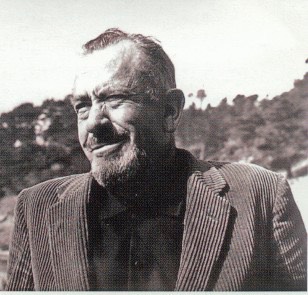
A paper examining 'Steinbeck’s Multi-layered Use of the Biblical Image’,
published in Michael J Meyer, The Grapes of Wrath. A Re-consideration
(Editions Rodopi, Amsterdam/New York, NY 2009) pp 129-148.
Papers on biblical imagery in The Grapes of Wrath are hardly new and references in books and articles on Steinbeck abound.1 Tamara Rombold,2 for example, sees the whole story as an inversion of the biblical narrative, with the dead child set forth on the waters as an inversion of Moses, and the drought in the opening chapter as an inversion of the creation story with the language inverting the order of creation as it appears in Genesis 1:13-18. These biblical tropes are followed by a reflection on Lot’s flight from the sinful Sodom and Gomorrah, powerful images of the Exodus and the Exile, and the depiction of Rosasharn Joad offering her breast to a dying man as an allusion to the new heaven and the new earth described by the prophet Isaiah (65:17; 66:22).
The purpose of this paper, however, is to focus on the author’s biblical understanding of wilderness, demonstrating on the one hand the close connection between that concept and the experience of the Okies and on the other an awareness of contemporary Jewish or Christian scholarship relating to the Hebrew Bible (or the Old Testament).3 By bringing the two together, I hope to enrich the meaning and significance of both for a wider and contemporary society, and to increase the interest of biblical scholars in Steinbeck’s work while at the same time encouraging Steinbeck enthusiasts to penetrate more deeply into some of the biblical background he employs in most of his canon. I hope also to draw attention to some of the ways in which Steinbeck not only reflects the biblical imagery but often goes beyond it, giving it an unfamiliar twist or opening up new visions and questions, often simply by the way he tells the story.
Superficially, the odds may be against such a goal. Realistically, Steinbeck could never have been described as 'a religious person’. Institutional religion played little part in his life and he would surely be offended by any suggestion that he was a Christian, but the biblical content in much of his writing nevertheless remains strong, leading John Timmerman to conclude some twenty years ago that Steinbeck’s use of the Bible in fiction showed how fascinated he was with the Christian story and demonstrated that he recognised religion as an undeniable force in the life of his characters.4
Some of Steinbeck’s religious interests no doubt go back to his Episcopalian parents who introduced him to the Bible and the traditions of the faith from an early age, starting with his mother telling him Bible stories when he was three. Later he wrote, 'Literature was in the air around me. The Bible I absorbed through my skin,' a comment that no doubt explains why his writing is so flooded with biblical imagery and symbolism, despite the fact that at least one biographer suggests that he began to question the idea of God and the place of religion in his early teens.5
Since covering all of this imagery would be impossible in a short essay, I have decided to focus on three aspects of biblical wilderness imagery as it appears in The Grapes of Wrath: wilderness as land, wilderness as an emotional experience, and wilderness as a means of renewal.
Wilderness as Land
Wilderness has been described by Carol Ochs,6 a teacher at the Hebrew Union College Jewish Institute of Religion in New York City, as 'the single most informative experience in the creation of the Jewish people' while Ulrich Mauser,7 a Professor of Biblical Theology at Princeton Theological Seminary, says that without it the development of religion in the Old Testament would be ’unintelligible.' In fact, the shaping of a religion is the underlying theme throughout the whole of the Old and New Testaments. Israel’s belief in herself depends on it. It is even possible that the whole Hebrew-Jewish tradition is shaped by this story of interaction between land and people although it may appear differently in different times and in different places. Wilderness in the Bible however is not all vastness, nothingness, horror, and disaster, though all those elements are there. It is, in fact, a very diverse arena — almost a cauldron (or in more familiar Steinbeckian imagery, a tide pool) in which all life takes place, where everything interacts with everything and everybody, and against which everything and everybody must be judged and valued. Similar claims regarding wilderness could be made for The Grapes of Wrath. In both cases, without this important image, there would be no story.
But does the Bible understand by ‘wilderness' what Steinbeck understood by it? The word occurs 245 times in the Old Testament and 35 times in the New8 but translations disguise a more varied choice of words in the original, and there are further differences when it comes to the Septuagint and the New Testament.
In the Old Testament, two Hebrew words that suggest wilderness9 cover everything from arid desert to pasture land and even include sparsely populated areas in 'the beyond.' Not less than 100 of the 245 occurrences of the image are found in the Pentateuch,10 all dealing with the wanderings from Egypt to Canaan, where the emphasis is much more on everything that happened in the wilderness rather than on what it was like to live in the wilderness, thereby making the wilderness little more than a backdrop for everything else. Of the remaining passages relating to wilderness imagery, many have a different emphasis and open up other avenues for exploration.
The Grapes of Wrath reflects a similar pattern of diversity of meaning for the word. Specifically, the terrain of Route 66 from Oklahoma to California has obvious similarities with Egypt and Canaan and dominates the whole, though wider wilderness concepts and ideas emerge as the narrative proceeds. Both the Bible and Grapes tell the story of a people escaping from a form of slavery. Both communities have their eye on a promised land. Moreover, their trials and vicissitudes, whether forty years or forty weeks, have much in common. What merits further investigation, however, is what Steinbeck chooses to tell about wilderness and the way he decides to present it.
Starting from the idea of wilderness as a backdrop, two examples that immediately come to mind are the relationship between the people and the land and the creation of community life based on this principle.
The People and the Land
For Steinbeck, wilderness is not so much rough land as a God-given space to which the residents are closely related. Though developed more fully in Viva Zapata,11 the same issues are present in the background if not the foreground in The Grapes of Wrath. To those who don’t live on it, a piece of land may look like useless waste. To business and commerce it may be a resource, capital, an opportunity for equity or real estate. But for those who live there, that land and its people enjoy a feeling of closeness and a sense of unity with it. It is more than the fact that the land belongs to them and that they belong to the land. They actually feel part of the land and the land is a part of them.
Steinbeck reflects this forcefully when Grampa refuses to go and has to be carried out,12 only to die almost before they have set off. His death, summed up by Casy with the words, 'He’s jus’ stayin’ with the lan’. He couldn’ leave it'. Steinbeck then takes the idea one step further,13 comparing the difference that occurs when a horse is replaced by a tractor, making it 'so easy that the wonder goes out of work, so efficient that the wonder goes out of land and the working of it, and with the wonder the deep understanding and the relation,' leading to a distinction between the man 'who is more than his chemistry' and 'the machine man' who, 'when the corrugated iron doors are shut . . . goes home, and his home is not the land.'
The approach of the Old Testament is similar, though possibly less focused and explicit, with more background and less foreground. Like the Okies, the Hebrews were not natural nomads for whom living in the wilderness was the norm. Neither they nor their immediate forbears had any experience of it. They needed a fixed area for their identity, to enable 'them to be them' and not somebody else. According to E W Davies,14 this is why land for the Hebrews was of paramount importance. Theologically, it summed up their relationship with God. Sociologically, it symbolized the equality that was supposed to exist between each person and their neighbour. The economic viability of each household and the health of the whole community depended on it.15
The conviction went back to Abraham, who was landless when he left Haran for Canaan with the promise of a new home not only for him but also for his descendants (Genesis 13:14-18), and continued as Jacob and his family settled in Egypt, leading later generations to a wide-scale movement of a landless people to obtain a land of their own.16 Once established, the Israelites consolidated the concept as they turned their attention to individual property rights, originating with the division of land between the tribes after they settled in Canaan. That land was an inviolable gift from God. Each individual household had a right to its share in the inheritance, thereby producing a kinship structure based on a large number of households. Building on this concept, many of Israel’s laws and institutions were designed to keep this structure intact.17
Through most of the Old Testament, the underlying ideal was that a family’s land should not be disposed of.18 Laws on transference of property had safeguards against the exploitation of the landless by the landed, and, though exploitation became a growing practice under the monarchy, much to the chagrin of prophets such as Amos and Micah, the laws also included both protections and limitations.19 To what extent these laws and customs were actually observed is another matter, but their very existence points to the way in which the Hebrews viewed land ownership and their relationship with it. It also kept them well aware of the consequences for their social structure when breaches were made.20
Whether Steinbeck was aware of all this is unclear, but, starting from the same point that the people and the land belong to each other, and viewing it squarely from the point of view of the victims of land seizure programmes, he spells out the consequences in no uncertain terms in order to explain why what was happening between Oklahoma and California was also unhealthy for the nation. Where there is ownership and property, there have to be defences. If the defences are breached, conflict results. If you can keep control in the hands of the elders, authorities, or powers-that-be, it may appear to work. Seen through the eyes of the victims and the nation as a whole, however, it is obvious that such a plan will fail.
The same underlying concepts are there in the Old Testament but seeing the issues from the point of view of the victims of land seizure, analysing the reasons and assessing the consequences for the wider community gives Steinbeck an edge over most of the Old Testament prophets, some of whom relied on dogma and were often too close to the establishment. Like them, Steinbeck lacked nothing in the force of his utterance. Like them, he stood back from political involvement and the implementation of programmes. But whereas they, for the most part, were are content to declare the principle and preach the message while patiently accepting the status quo, Steinbeck sees the principles in human terms, puts flesh on the bones and spells it out in story form: Nothing could be more powerful, few things more prophetic, than
'two men squat on their hams and the women and children listen. . . . Keep these two squatting men apart; Make them hate, fear, suspect each other. Here is the anlage of the thing you fear. This is the zygote. For here, "I lost my land" is changed; a cell is split, and from the splitting grows the thing you hate — We lost our land'21
Similarly, the family with a little food feels the need, even the desire, to share with those who have none. The family with one blanket on a cold night sacrifices it for the sake of a baby with a cold in another family.
The whole attitude to life is changing and, in case the reader misses it, Steinbeck spells it out later in more detail as Tom explains the change that has come into his life, backed up by biblical quotes.22 Tom recalls Casy saying once how he went out into the wilderness to find his own soul only to discover that he didn’t have a soul that was his. Instead what he found was that he had just a little piece of a great big soul and his little piece was no good unless it was with the rest.23 ‘This,' writes Steinbeck, 'is the beginning—from “I" to “we”.’24
I have explored elsewhere25 in some detail the common ground and divergences with reference to Wheeler Robinson’s theory of corporate personality and A R Johnson’s researches into the relationship between the individual and the community under the heading 'the one and the many' (the ‘I’ and the ‘we’) in Hebrew thought, and noted that both were writing about the same time as Steinbeck was busy working on The Grapes of Wrath, but this is Steinbeck working his way from the self-seeking individualism of Babel (Genesis 11:1-9), through 'the one and the many' in Hebrew thought, to a discovery of a more healthy relationship between individual and community with the common language of Pentecost (Acts 2:1-12).
The Old Testament trod a similar path as the Jewish people worked through the same problem and spent nigh on a thousand years in doing so, yet without ever achieving the sharp simplicity of Steinbeck’s identification of the causes of conflict and the consequences for a community where ‘I' is always dominant and the importance of 'we’ ignored.
The Creation of Community
Steinbeck’s account of how 'a rabble' (mostly quite unrelated to one another) come to organize themselves bears a striking resemblance to the biblical attempt to assert some form of order through the Ten Commandments. Chapter 17, for example, describes how 'in the evening . . . twenty families became one family’, and how despite their timidity and the tumbling world in which they found themselves, 'gradually the technique of building worlds became their technique, then leaders emerged, then laws were made, then codes came into being. Soon punishments were laid down, and rights established and observed’.26
On the surface, the similarity to the Hebrews is not surprising. They were after all two communities in similar circumstances, but readers familiar with the biblical text are unlikely to miss the similarity of detail. Noise and privacy may not have been much of a problem in an Israelite settlement but personal relationships, rape, seduction, adultery and murder all certainly were, as also was a concern for the basic human rights of feeding the hungry and caring for the sick and needy. With similarities like that, Steinbeck might almost have been accused of lifting the story straight out of the Bible. On the other hand, the circumstances from Oklahoma to California being what they were, he had no need to, but it is hard to resist the conclusion that the biblical narrative was never far from his mind, consciously or subconsciously.
A more interesting question is the way Steinbeck handles it. What does he put in? What does he leave out? Where does he place his emphases and how does he tell it, bearing in mind the resonances that his language, phrases, and imagery would have for his readers, and never forgetting that since he was writing a novel and therefore totally in control of his material, he might well have told it so very differently?
In Exodus, for example, Moses proclaims the Ten Commandments to the tribes of Israel, which come down from above in autocratic fashion and, in the words of one Old Testament scholar,27 appear to have been written in the interests of an author who was
'male, an Israelite, employed, a house-owner, married, old enough to have working children but young enough to have living parents, living in a “city", wealthy enough to possess an ox and an ass and slaves, important enough to be called to give evidence in a lawsuit. It is a man who is capable of committing, and probably tempted to commit, everything forbidden here —and likely to ignore everything enjoined here, if not commanded to observe it.'
In contrast, Steinbeck saw it through the eyes of the Hebrews and the Okies, not Moses or Aaron, not through Pharaoh, the banks or the businesses, but through the eyes of the common people. He saw the price they were called upon to pay. He saw a world where rules and laws, bordering on basic human rights, arise not as an imposition from a higher authority but from the basic needs of the people, and told it in the light of his own experience, presenting not a totally different picture but one with significant variations and (some would say) significant enrichment of the initial facts and tenets of the earlier narrative.
Wilderness as am Emotional Experience
Biblical wilderness, however, is as much about human experience as it is about land. So also with Steinbeck. As noted earlier, the original biblical texts conveyed a more varied understanding of wilderness by a choice of words not carried through into most translations, particularly in the case of the Septuagint and the New Testament where the Greek, e0rhmoj, with a root meaning of abandonment, may refer not only to a locality but also to a person or a cause. For John the Baptist in the wilderness or Jesus on the Mount of Temptation, for example, the wilderness world is a complex mix of environment, mental state, and a deep sense of isolation due to emotional stress.
The Israelites had a similar experience. The wilderness for them was more than simply a backdrop. It was an integral part of the story, reflecting something going on at a different level in their hearts and minds. To the practical horrors of life in the wilderness, this extension of the wilderness concept provides further convenient imagery for a whole community uprooted, lost, and left to wander for months if not years in a vale of hardship, suffering, and privation, with no sure prospect of ever arriving and no clear concept of what life would be like if they did.
Walter Brueggeman28 suggests that though the terrain was initially a shock to their system because it came as a surprise, what came much nearer to destroying both Israel and their faith was something else. The major challenge of the wanderings was not something geographical, not an 'in between' experience (like an air flight that simply makes the journey seem longer) nor a sandy or tough terrain demanding extreme stamina. The major challenge and the root cause of their murmurings, protests and quarrels (Exodus 16) was 'space far away from ordered land'. They were 'cast into the land of the enemy — cosmic, natural, historical — without any of the props or resources that give life order and meaning' with consequential emotions of danger, fear, isolation, and loneliness (all closely associated with religion), and the terrain is not so much film music to intensify the telling feelings as carefully designed scenery and light effects which intensify. These two worlds then come together as the geographical wilderness underlines and brings out the emotional wilderness and 'wilderness’ becomes an image for a lostness when and where all things fragile need special care and attention.
On a more personal level, the concubine Hagar29 is an excellent example of one individual where the two worlds meet as the wilderness epitomises her sense of loss and rejection and, at the same time, intensifies the fragility of her emotions on two separate and quite different occasions: one of her own choice when she is running away because life in the Abramic household is intolerable and the other imposed on her when she is driven out because Abraham and Sarah can no longer tolerate her presence.
In The Grapes of Wrath, Casy the preacher epitomises the wilderness in which the whole community finds itself. Casy has lost his faith. Like the Okies, he has no idea where he is or where he is going, and he knows it. He used to be able to preach a good sermon and have the people 'jumpin’ an’ talkin’ in tongues’.30 Now, with nothing to say, he cannot even preach a bad one. He used to know where to lead the people. Now the shepherd is as lost as the sheep. He used to be ‘different'. Now he is just like everybody else.
For the Okies, similarly, the bottom has dropped out of life. Religion, once the glue of society, is now no longer the central force that holds them together. All the fixed points have gone. Those whom they trusted and relied on, like the banks and the landowners, could be trusted no more and any suggestion of a vision or a new way of life with high hopes and expectations was at best distant and at worst illusory. As if that were not enough, the road was rough and the terrain threatening.
In their emotional nightmare, the Okies turn to Casy as the Israelites turned to Moses, and, the way Steinbeck tells it, whether by accident or design, suggests the two men have much in common. In reality, neither is quite the man the people thought he was. Both have a past. Moses has taken advantage of his privileged position as the adopted son of Pharaoh’s daughter and therefore can commit murder without fear of retribution. Casy has taken advantage of his privileged profession and had his way with the girls. Neither has been able to face up to what he has done. Moses escaped to the land of Midian and the protection of his future father-in-law, Jethro. Casy surrenders his holy orders. Both then find themselves thrust back into the wilderness in spite of themselves as people turn to them, look for leadership, make impossible demands of them (Moses), and press them with unanswerable questions (Casy).
There the similarity ends, but in fact, the differences in the two may be more significant. In the case of Moses, one cannot help but wonder whether, despite the sense of call and the outward display of confidence, there were times when he experienced an underlying and not too deep element of uncertainty, if not insecurity, due perhaps to the fact that his call was not acknowledged by others as he would have wished or possibly due to the circumstances of his adoption. In his uncertainty, he looks for outward signs and support. Unlike the psalmist whose confidence came from the hills,31 Moses derives his confidence from some 'higher authority' who resides in the hills but is carefully concealed from those who look to him for guidance and whom nobody but Moses is allowed to contact. When things go wrong and he finds himself caught between the people and his God,32 anger surfaces as he turns from one to the other. Moses keeps himself and everybody else going by his vision and his dynamism but also by internalising his doubts. Eventually, he dies disappointed and unfulfilled, only seeing the Promised Land from a distance and never being allowed to enter it (Deuteronomy 32:48-52).
Casy, on the other hand, lacking any such appeal to an external authority, finds it easier to surrender to events and to come to terms with the harsh reality he must face. Unable to live up to his ideal of personal ministry, he no longer requires anything of others, comes down from the mountain and joins in the struggle with the rest. With no answers or solutions to offer, he can only endure what is happening, share in the suffering and work out the answers with others as they go along; yet one important result of his openness with the community is his ability to open doors for others, one of whom is Tom Joad. As a result of his contact with Casy, Tom’s whole attitude to life changes, and the ripples from this reformation can be seen rolling out as Tom tells his story and so preaches the sermon through his own experience in a way that Casy never could.33
For Moses, there had to be a promise and a purpose. For Casy 'there’s just stuff people do’,34 and, once readers grasp that, the image of the wilderness begins to speak with a new voice as the geographical wilderness and the emotional wilderness take one step closer to each other and their union suggests that the wilderness may ironically be a source of renewal.
Wilderness as Renewal / Redemption
Once those two worlds come together new factors come into play and the first clue comes in ‘Time and Torah’ by Franziska Bark,35 in which she draws attention to a fundamental difference between Judaism and Christianity, when she says of the slaves coming out of Egypt that
‘they removed . . . pitched . . . journeyed . . pitched. . . . went. . . pitched. . .
removed. . . (and) encamped. . .’ but in the Torah they never arrive.36
Deuteronomy stops on the threshold. Fulfilment must wait till Joshua. The promise of Canaan (Exodus 6) may be what gets them going and what defines both the goal and the direction. The significance of the wandering cannot be seen without it, but the arrival is not the sole aim and purpose. Even to see the wandering as a means to an end would be misleading, for what we are seeing here is one of the fundamental differences between the Torah and the Christian tradition. What matters to Christians is goal, climax, telos or arrival. What matters to the wandering Israelites is ‘a future becoming’ by the continued ‘walking in the ways of God.’37
Recalling that Steinbeck was by no means ill-informed about Judaism and had his own Jewish contacts38 it may not be accidental if Casy is cast more in the Jewish than the Christian mould, with an emphasis on the ‘now’ rather than the ‘telos’.
The differences may not be as great as at first they seem but if we stay with Steinbeck for the moment we at least get a hint in the case of Tom Joad that the wilderness is not all negative. The hint is then clarified and fortified in the final pages of the novel which make an equally if not more powerful statement as to what can happen to those who are able to live in the wilderness, survive in the wilderness and patiently wait. Even the wilderness may come to be seen as a place of renewal.
Sealing the message of the whole book as a story of survival, it comes to what many have regarded as an abrupt ending, with people struggling to survive in a flood of biblical proportions, where a helpless child with a dying father produces a dry blanket to enable Rose O’Sharon to change her wet clothes, where Rose O’Sharon, who by this stage has lost her child, offers her breast to the boy’s father who has not eaten for six days and is starving to death, and where her mother looks on and says,
‘I knowed you would. I knowed you would’.39
Critics were quick to point out that at least at the end The Grapes of Wrath was a fair picture of the true situation. Arriving in California was an abrupt experience. There was nothing to look forward to. No promised land. More sympathetic readers, including Steinbeck’s publishers, wanted to change it.
The publisher’s problem was not so much the content of the ending nor the idea that life must go on, nor even the details of the baby, the boy and the starving man. It was, said his publisher, just a bit too abrupt. It needed some build up, like an earlier hint of some relationship between Rose O’Sharon and the starving man which should be ‘not so much an accident or chance encounter, but more an integral part of the saga’.40
Steinbeck’s reaction was vehement. Nothing would make him change it. Defending the idea that the ending is intended to be casual, he wrote,
‘there is no fruity climax, it is not more important than any other part of the book — if there is a symbol it is a survival symbol not a love symbol, it must be an accident, it must be a stranger, and it must be quick. To build this stranger into the structure of the book would be to warp the whole meaning of the book. The fact that the Joads don’t know him, don’t care about him, have no ties with him — that is the emphasis. The giving of the breast has no more sentiment than the giving of a piece of bread . . . I am not writing a satisfying story . . . I tried to write this book the way lives are being lived not the way books are written.’41
There was no happy ending for Steinbeck, any more than for the Oakies. The land of promise, even if it existed at all, certainly did not come up to expectations. There was still endurance, struggle, survival, but always in that survival the possibility of a new humanity. Wilderness always holds within itself the possibility of renewal provided renewal is not confused with restoration.
So has Steinbeck a different message from the Old Testament or is it just a different ending? Neither, because once we grasp what Steinbeck is saying we find that the seeds of his ending are already there in the Old Testament, though not immediately obvious, and though it did not need Steinbeck to find it for some. other readers of Steinbeck might find it easier to spot it in the scriptures once they have found it and recognised it in The Grapes of Wrath.
Whilst acknowledging the universally recognised negative images of fear, repulsion and hostility in the wilderness, Leal42 for example, draws attention to the fact that in the Old Testament the wilderness experience is not all negative. From time to time it is the site of encounters of considerable personal and national significance, where people are challenged, tested and called to important tasks. It is the site of God’s grace expressed through history as he disciplines, purifies and transforms, and at one point43 Leal sees wilderness as a place where faith may turn uncertainty into confidence and depression into hope. Wilderness is an aspect of God’s good creation, to be honoured and regarded with awe as well as occasionally providing a spiritual haven for those in need.
Brueggemann,44 similarly, in a detailed study of Exodus 16 and Numbers 14, presents a picture of biblical wilderness as a place of hope and renewal. In Exodus 16, when the people feel they have lost even what little they had in days of slavery, they then discover that there is still rain, meat and bread (vv 4, 8, 12) and that they can experience in the wilderness what previously they thought they could only have in Egypt. Further unexpected sustaining resources turn up again in Numbers 14 in spite of landlessness, while the imagery of Exodus 33: 21-2345 suggests that we only appreciate the new when we look back and sense the mystery of how a place of death and misery which looked like the end could turn out to be a new beginning where life is given. So it is that a people so closely related to the land may come to see that life is possible without land, or at least with different land,46 and therein lies the hope that keeps them going and makes new life possible. Summing it up, Brueggemann says God’s presence,
'is evident in his intervention not to keep things going but to bring life out of death,
to call to himself promise-trusters in the midst of promise-doubters’.47
Steinbeck taps into much of this biblical wilderness imagery but not without adding one further image — the Turtle.48 Could this also be something which Steinbeck had imbibed with his mother’s milk or picked up from those Bible stories and the way she told them? The turtle is a prize example of survival and the embodiment of Casy’s view that ‘There’s just stuff people do’ (or ‘Things happen’) but once again Steinbeck puts his own stamp on it. At one point in the struggle for survival the turtle unwittingly picks up ‘one head of wild oats’ and soon afterwards in an incident with a lorry in the course of which the turtle very nearly lost its life the head of wild oats fell out and ‘three of the spearhead seeds stuck in the ground’. The turtle unwittingly went on his way.
For Steinbeck that turtle was the prize image of the Oakies. The Old Testament doesn’t have exactly a turtle, but it has wilderness, and if the biblical wilderness helps us to appreciate The Grapes of Wrath. The Grapes of Wrath maybe can help us to spot the turtle in the Old Testament.
Steinbeck is a writer with a deep awareness of the biblical narrative, who has absorbed its inner meaning, sifted out what was important and either dismissed the rest or given it a different twist. He knows not only the story but what the story has to say, and demonstrates a rich experience of life and an instinct for relating the one to the other. What better prophet or theologian could one wish for.