
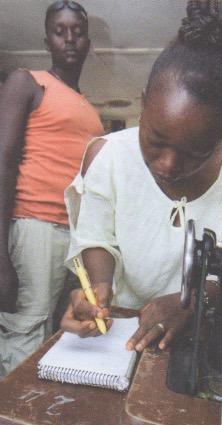
"International Literacy Year will not mean very much until politicians put the subject high on the political agenda. One of the problems is that the politicians are not very interested in it, and the position will not change until they are competing with one another to see who has the most literate constituency."
Thérèse Rickman Bull, wife of the Canadian High Commisioner and Acting Director of ALOZ, 1989
INFORMAL ADULT LITERACY EDUCATION (as opposed to formal literacy support, rightly the responsibility of governments and larger agencies) was always an important feature of the FTM programme and would often include support for books for new literates to practice their new-found skills.
Many such books handled Christian themes but were equally sensitive to what people really wanted (and needed) to read about, and very much once again in the tradition of Bray and Murdoch, with subjects such as health and hygiene, nutrition and a wide variety of basic skills for life. More recently the trend is to encourage and support the projects which produce texts as part of literacy education process.
Wall Libraries, Book Vans and Travelling Libraries
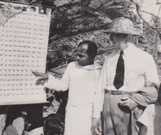
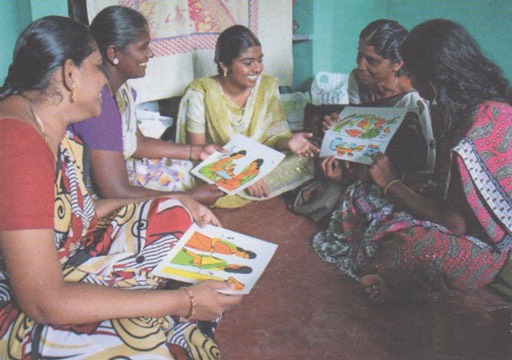
Frank Laubach, an early 20th century missionary to the Philippines, who worked out the first edition of the now world-famous picture-word reading charts based on associating the shape of a letter with a picture, enabling what was sometimes known as ’lightning literacy’, seen here discussing this chart of the Tamil language with a literacy teacher in the course of a Literacy Campaign. Laubach also pioneered the volunteer method of promoting literacy known as 'each one teach one' so that literacy instruction could continue to spread widely once the Campaign teachers had moved on elsewhere.
The Wall Library was Step One on the Literacy Ladder in many Literary Classes and FTM commended them and supported them avidly. Their simplicity, practicality and low cost, together with a strong personal element were their hall marks of success, making them popular with donors and fundraisers alike, able to appreciate what they were providing. Space for books in the homes of many students was limited but the walls were often bare, so why not a wall library — simply a piece of cloth about six feet by four feet with twenty pockets. Students were encouraged to make their own as they learned to read. On completion of their Reading Course they would be rewarded with 20 books, one for each pocket and (on the Laubach principle of ‘each one teach one’) were then expected to instruct another student in how to collect their Wall Library.
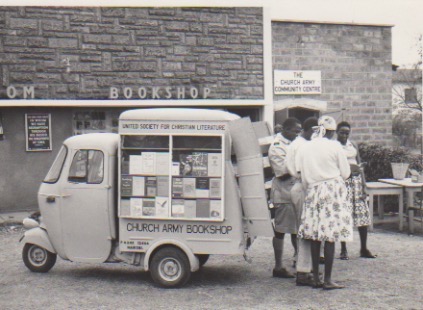
The Book Van was a natural progression from the colporteur on foot or on his bicycle and Book Vans flourished in Africa and Asia, often proving expensive to donating charities because of the load they carried and the rough roads on which they often had to operate, but their arrival in a village would be warmly welcomed by aspiring new readers anxious to lay their hands on something to practice their new skills.
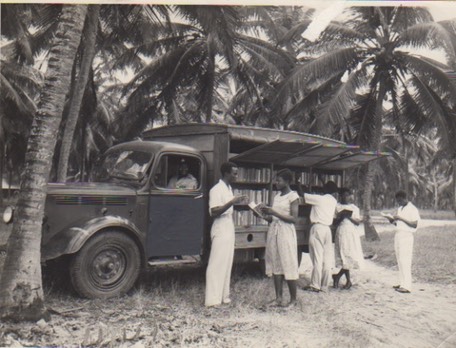
The Library Van was the next step for new readers, similar to the Book Van but significantly different and free. Regular visits enabled people to be introduced to a wide collection of material, to sample books before reading them, whilst the Van’s return visits not only developed the reading habit but also ensured that it was kept alive once the Campaign moved on. It was also the means by which publishers and booksellers got their stock to outlying areas, local people covering running costs once the outlay had been taken care of.
More serious than the dearth of literature for new readers, however, was education and an understanding of the social factors and conditions which too often limited pupils' achievements. Three examples, from three different continents (Africa, Asia and Latin America), addressed literacy in much the same way but with slightly different consequences. Two of FTM's major partners, two of which did not fail to miss an opportunity provided by National Literacy Day to bring it home to students, their families and friends, including one FTM member of staff who was visiting and able to join in. In Zimbabwe it was a question of misogynism.
National Literacy Day in Harare: A Brief Drama
In a highly amusing and entertaining sketch a tense husband explains to his wife that he has just received a letter from the local furniture company to say that because they have fallen behind on their payments they will be coming round in a few days to re-possess the furntiture. In the course of the day his wife shares her misery with a friend who had been attending literacy classes.
After expressing the usual consolatory remarks she asks to see the letter. Her countenace changes. 'This is not a letter from the furniture company', she explains to her illiterate friend. 'Then (as gently as she can) 'I am afraid it is a letter from your husband’s girl friend in a neighbouring village telling him that she is pregnant and will he please come and help her to look after the baby when it is born'. The curtain comes down to uproarious applause. Now they know why some men (too many men) are not too keen on their wives learning to read, and definitely not write.
ALOZ (Adult Literacy Organisation in Zimbabwe)
ALOZ, in the late 1980s, with roots going back more than sixty years, had over 100 literacy teachers each with a mini-library and a regular supply of newspapers and magazines for teaching purposes. They also had nearly as many teaching centres, each of which needed a local reading room if not a library. Many were housed in a local church or school and there was a natural spin-off for the organisation that provided the accommodation, but all the community must have access. For adult literacy teachers, however, the ability to read is not so much a step on a ladder as an open door to a new world enabling students to develop basic skills such as record keeping and leadership, self-reliance, coping with savings clubs and income generating projects. In short, it gave them Laubach’s 'voice in public affairs' — a benefit not always welcomed by those who want to remain in their comfort zone.
In Zimbabwe that was the men. Bangladesh was different, Costa Rica more so, but in every case it meant that there was more to grants for literacy than simply learning to read and write and that is why funding from FTM was so important.
LISA (Local Initiatives Support Action)
LISA was doing much the same job in Bangladesh on which the Overseas Development Administration commented that women’s lives in Bangladesh were changing as a result of such activity. More women, for example, were reading the small print, checking the details before signing anything,ensuring their names were on voters’ lists, shoowing more interest in health, hygiene and children’s education, and developing a new sense of pride and confidence. They were also demanding higher wages as reading groups began savings groups and women began to have money of their own.
Here the reaction of the men was very different. Unlike the men in Zimbabwe who felt threatened by 'reading wives,' men in Bangladesh decided to take them on with the demand for literacy for men which grew apace. If that mean classes in the evening, 'no problem' said the men. If evenings in a Bangladesh village were dark, which they were, 'no problem' said the men. 'We bring our kerosene lamps and do the best we can.'
Acquiring the skill to read and write is fundamental to a fulfilling and useful life but it is ONLY THE BEGINNING
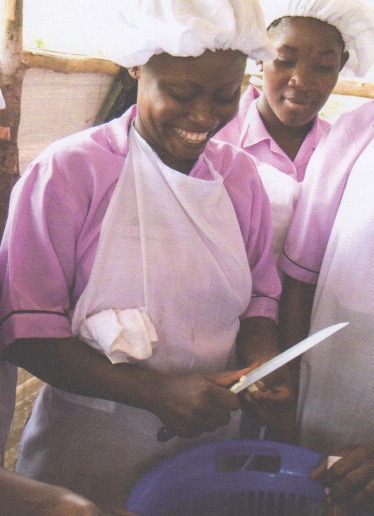
Despite all pressures, tensions and in some cases even battles Literacy Opens Doors to an abundant life as demonstrated by these women, by the expressions on their faces, their busyness, their sense of urgency and commitment and the satisfaction to go wih it or this man whose Literacy Training has opened the door to Skills for Life giving him a job, an income, responsibilities and self-fulfilment. or these nurses whose Skills for Life opens the door to a healing ministry

For some Literacy is the first step to making decisions in the home
For others the first rung on the ladder to having A Voice in Public Life with some social and political involvement in bringing about change for others
ALFALIT, Latin America
ALFALIT started life in Florida in the early 1960s as a missionary literacy operation, though how much it was committed to literacy per se or to literacy as a means of making converts depends on who you talk to. By the mid 1980s, however, it was clear. The break with Florida had come and ALFALIT was an indigenous Latin American organisation, with headquarters in Costa Rica and programmes in seventeen countries.
With a wide churchmanship relating to over 1,000 churches and 150 denminations, many of them Pentecostal, its agenda too had changed, finding a new role as an agency of change through literacy and literature alongside other programmes including adult basic education, disaster relief, advancement of women and literature production, all aimed at helping marginal people to improve their economy, provide simple health education for health workers, and training church workers to be agents of change in their own communities. It was an ideal partner for FTM provided the grant could be directed at some particular part of the literacy programme and not simply a general grant which could too easily get lost in the overall running of the organisation.
The partnership with ALFALIT in Latin America focused on the headquarters in Costa Rica and this account by an anonymous FTM visitor recounts events on a National Literacy Day summarising the nature of the work, the enthusiasm of the participants, and the way they saw literacy as key to a different way of life.
Now for One wth a Difference
The Maya in Guatemala provide one example with a difference. With more (mostly fundamentalist) Protestants than any other Latin American country, the Conference of Evangelical Churches (mostly genuinely Indian and representing Methodists, Mennonites and Presbyterians) ran a programme of theological education aimed at promoting a genuinely Guatemalan theology reflecting on the meaning of Christianity and the purpose of life in their situation. Living in such straitened circumstances learning the art of reading for its own sake was a non-starter, but the urge to read in order to cope with 'the purpose of life' was something different, so ALFALIT decided to focus on that. But where were they to find the texts for new readers on that topic? FTM weighed in with them to provide something on Justice, Peace and the Wholeness of Creation.
In some cases literacy alerts readers to their environment.
In others the environment provides the spur to literacy.