
THE FTM CAMPAIGN was launched at an event in St James’s Palace in October 1964, presided over by the Archbishop, attended by the Prime Minister, and commended ‘in a memorable speech’ by the Queen Mother.
It was followed on Bible Sunday with a special service in Westminster Abbey at which (for the first time) the choir sang the Campaign Hymn written for the occasion by Charles Jeffries. There were 24-hour readings of scripture nationwide and the national press which had virtually ignored the launch at St James’s Palace began to show a little interest.
Actors, artists and party political leaders (Winston Churchill, Harold Macmillan, Harold Wilson and Jo Grimond) all gave their name to it. 400 Councils of Churches were asked to make contact with their local civic authorities to set up FTM Committees in every city, town, and large village. Mayors from civic authorities all over the country pledged their support. The country was to be bombarded with posters, radio and TV appeals, and a Feed the Minds Week every autumn.
JOYCE GRENFELL, a friend of FTM and the organisers of the York Book Fair, often turned up.
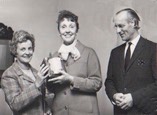
She records how on once, travelling in South Africa, her chauffeur was a young black African of 25 called Nicodemus. In conversation he talked about the books he had read, thanks to a Methodist Reading Club. Then he said,
'I am going to many places in books.
All the time I am travelling in my head'.
On returning to England she wrote 'Travelling in my Head’, with drum beats as accompaniment and the middle verse as a chorus, and donated the copyright to FTM.
Because the Bible Society already had its own Campaign Committee and close links with the AYF, much of the preparatory work was done by a Bridge Committee (forerunner of the Feed the Minds Committee and sometimes referred to as such) consisting of the Bible Society, the AYF and Public Relations Consultants Howard Phillips Ltd, with representatives of the other two Committees, SPCK and USCL. Their responsibility was for those parts of the Campaign to be handled as a combined operation which meant regular committee meetings and parallel groups of the Visual Aids people, Public Relations Officers, Education Secretaries and Home Secretaries of the three bodies (AYF having no comparable infrastructure), something which had never happened before and a direct result of the Campaign.
It was confidently anticipated that the bulk of the money would come from commercial and civic sources and be the beginning of a long and continuing programme parallel to Christian Aid and Oxfam to deal with the population and literary explosions overseas which were expected to continue for many years to come. Churches were to be the main thrust but the Call was to go far beyond the churches because the end product would have effect ‘far beyond the bounds of the church in other lands.’
The Book Fairs
Book Fairs played a significant role in Campaign Fundraising. Sending old books overseas was neither desirable nor practical but selling them was and Book Fairs provided a good opportunity to clear out the bookshelves, to make good titles available to others locally at a fair price (often 5 or 10 pence), to raise thousands of pounds for the Cause, and with a handy spin-off for promotion and publicity all at the same time. Some, notably York and Norwich, were large operations lasting several days and became an annual event over many years. Others were one-off occasions ranging from a small affair in a private house to a village church hall, a couple of days in a city centre or an empty shop rented for a week. York, one of the first and biggest, and carefully nurtured by Dorothy and David Blunt, ran annually until 2015, the early ones going over three or four days, and by 1985 the annual takings were in the region of £4,000. Norwich, similarly, which came on board in 1970, was organised annually by Waltraud Jarrold who still runs it.
Aspirations unfulfilled
Sadly the reality failed to come up to the expectations and the Campaign never really got off the ground. Most denominational bodies gave it their support, at least to the extent of passing resolutions and commending it to their constituencies, but much of it did not get any further. Churches were lukewarm and missionary societies showed little enthusiasm actually to get involved in the Campaign, either because they were pre-occupied with their own programmes or because they saw it as something of a threat to their own income. The response from the pace-setters was disappointing, as was an appeal to 1200 major companies most of which found the focus too narrow, and Charitable Trusts showed a remarkable lack of interest. A TV appeal struggled to raise £8,000. After one year there were only 35 local committees and no more than 200 a year later. After three years the total had barely reached half its target of £500,000.
Three Issues Undermined Success
Did It Work?
Yes
Without it Feed the Minds would not exist today and enjoy an independence which enables it to put into practice the basic priniciples on which the literature societies worked and which the Campaign set out to strengthen.
"The value of the Campaign was more than the money it raised … it has made that phrase (Feed the Minds) a part of our common Christian vocabulary both in this country and right round the world’. (Cecil Northcott, writing in the British Weekly, 1967.)
No
The money raised failed to come up to modest expectations and the resistance to changing the approach of the Societies to the Cause and the changes needed to maintain momentum was too strong.
'in terms of this world’s values, the Campaign has failed … wasteful of money (and) inefficient use of all too few skilled workers … three separate appeals by different societies’ … (rather than) … one united appeal … (and) the primary cause … the complete unwillingness of the principal societies involved to accept the need to unite'. (Two FTM Yorkshire lay Campaigners (one Anglican, one Methodist), in a letter to the Church Times, July 21, 1967).
Costs
Originally estimated at 3%, costs went through the roof in the first two years and though they came down to 20% in the third year the overall average was still nearer 50%. In October 1965 New Christian published a critical article pointing out that at the end of the first year the Campaign had failed to cover its costs (then running at £94,250) and followed it up with a second article in January 1966 in case the point had been missed. Some positive support came from the British Weekly which argued that the value of the Campaign was more than the money it raised and that it had made that phrase (Feed the Minds) a part of our common Christian vocabulary both in this country and all around the world but it was not enough to nullify the overall effect.
Confusion
The original plan to divide contributions through the Bible Society and the AYF on a 60/40 basis soon proved detrimental. The general public could see no reason why they had to be divided at all when they were all committed to the same purpose and found the proportions even more puzzling, so it was quickly agreed to change to 50/50, adjusting the cost-bearing ratio similarly, and to discontinue separate appeals for the AYF in favour of Feed the Minds.
To make matters worse, SPCK, USCL and the Bible Society could never quite muster the courage not to appeal under their own names and though they sent out the message that whatever they received in their names would be channelled through Feed the Minds the general public found it all very confusing.
Two correspondents to the Church Times attributed the failure to ‘the complete unwillingness of the principal societies involved to accept the need to unite now’, charging them with wastefulness and inefficiency, trying to put new wine into old bottles, issuing three separate appeals when one was needed and trying to maintain ‘separate, independent and self-perpetuating’ units. This was not a case of the trumpet giving an uncertain sound. It was more like three trumpets giving conflicting sounds and trying to convince people it was one tune while at the same time giving out a fourth.
Objectives
There were tensions from the beginning between those who wanted all the emphasis on the distribution of Bibles and those committed to a worldwide programme of indigenous Christian literature development. The Bible Society was single-minded. The AYF, with its own Trust Deed and Organising Secretary was committed to the WCC/CLF with a broader agenda and a more modest target. SPCK and USCL, already in preliminary discussions with each other and with the AYF, were by tradition with the AYF/WCC/CLF approach, knew they could not afford to be left out and (true to themselves) pressed for the inclusion of other religious publishers and certain secular publishers on the grounds that anything short of a combined enterprise on a large scale would be ineffectual.
In February 1963 SPCK, in accordance with Literature for the Anglican Communion, 1960 (with support from USCL), affirmed that
‘any appeal directed to the general public must be for good literature of all kinds for the developing nations, not merely for specifically Christian literature’.
By the beginning of the third year the organisers knew that the Campaign was not sustainable. It had to be either a long campaign to justify the investment already made or a short one with hoped-for very long-term results. The first was no longer an option. The second was a possibility. The result was that at the end of the third year the Campaign came to an end and Feed the Minds metamorphosed into Joint Action for Christian Literature Overseas (JACLO), retaining Feed the Minds as its fund-raising slogan.