
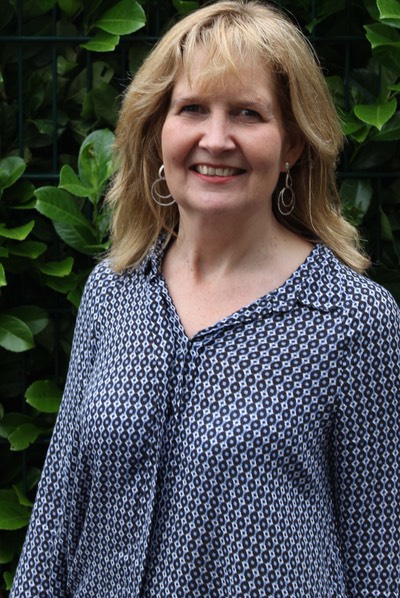
A Postscript by Josephine Carlsson, Director
At the Crossroads
When I was appointed as Director in 2007, Feed the Minds had a long and interesting history, but enforced rapid change was in the air and the organisation was at the crossroads. The pressures for change were partly internal and partly the result of the changing context in which we had to work, so it was not altogether a surprise that my first assignment from the Trustees was to work with them to produce a new strategy for the next five years based on the vision and mission statements developed a year earlier.
First, it was not easy to clarify the identity of a relatively old organisation with so many different projects and stakeholders. Second, the economic reality soon turned out to be more than a little challenging, the previous membership model being quickly dismantled as most of our supporting agencies and churches were finding it difficult enough to finance their own work, let alone a joint effort. We knew we had to redefine ourselves. But how?
After discussion and heart searching we are now defining ourselves as an international development charity committed through education to supporting some of the world’s most marginalised individuals and communities as they move out of poverty. In practice, the cornerstones for what we do are the right to relevant education and to literacy in particular, always bearing in mind that literacy is more than simply learning to read and write or carry out calculations; in people’s lives today it is linked to key challenges with learners gaining skills with a purpose.
Skills with a Purpose
Where to Begin
Getting to grips with the new organisation meant I had to understand the history. What had they actually done? In that quest one of my most important guides was Alec Gilmore, especially some of his unpublished writing which has now finally been sharpened up and edited into this publication. I soon realised that my first task would be to streamline what Feed the Minds did, using our limited resources wisely but without losing the ethos, history and uniqueness which lay behind the original efforts to support literacy, publishing and the power of the written word in the many countries where Feed the Minds was working
As I read the history, however, I was struck by how up-to-date the philosophy and methods of Feed the Minds always seemed to be. From the very beginning, believing in local initiatives, sustainable practices and new technology resonated strongly with what I had learned and seen working successfully through my own experience of working in Latin America and African countries. It even had links to what I grew up with — the stories of my parents and grandparents from their years in China and the respect for the local culture and understanding that was such an important part of their life as missionaries — so it was not difficult for me to continue that tradition. I felt at home.
Modernised Governance
Nevertheless, Feed the Minds’ programmes did have to change. If we were to attract new funders programmes and projects had to be more specific, with clearer criteria, rigorous monitoring and evaluation in order, together with new processes emphasising transparency and compliance with regulations and donors. Structures of governance too had to be modernised to reflect a new organisation unfettered by a plethora of member organisations. New technology and the opportunities to interact with our partner organisations via e-mail, Skype and other virtual methods of communication had to be taken into account as had different ways of working, always bearing in mind changes in the staff team and the staff team workimg differently. Fundraising too had to change drastically, especially as SPCK, a major contributor from the beginning, found it necessary to withdraw funding due to changes in its own organisation.
On reflection, I am mildly surprised that we managed to do all this. None of it was achieved without more than our fair share of difficult decisions and compared to the breadth of focus in earlier years our focus had to be narrowed, but with a fantastic staff and a wise and strategic Board of Trustees, all became possible.
Change and Continuity
Long-standing support for theological college libraries continues through our Overseas Book Service, thus maintaining a long tradition incorporating history and mission of our connected charity, USCL, but with our current commitment to Local Initiatives our overriding mission today is Adult Education and Community Development, with grants for publishing and printing left to other organisations who see that as their speciality.
New Start — New Methods
With this new Mission the change in Feed the Minds over the last five years has been remarkable. Some would say we have become a different organisation. In that time we have gained increased recognition in our sector and achieved our strategic objectives including significant financial growth to enable programme growth. Our charitable spend ratios are excellent and evidence of our efficiency. Such rapid development is the result of adapting to new funding climates, responding to challenging targets and continuing to focus on adult literacy to support empowerment, all now embedded in all our programmes. A truly professional organisation at a time when many charities struggle.
In 2015 Adult Education and Life-long Learning were finally included in the internationally agreed Strategic Development Goals which will strengthen our position in the future. We are also mindful of the danger that new and innovative development efforts will further marginalise people with low literacy skills, at risk of being 'left behind' in a world that is even more connected and reliant on literacy skills when it comes to technology, leaving us with an even stronger incentive to focus on literacy.
Another significant factor in our renewal is increasing recognition in the international Development Sector of the efficient model of working through partner organisations in order to connect with local communities, our role being an emphasis on facilitation, capacity building and mutual learning.
Further Adaptation
Not surprisingly, rapid growth has called for further adaptation with new governance structures, wider recruitment of trustees and defined our partnership model. Our new legal status, governance structures and presence in Scotland and Ireland represents opportunities for us to continue to grow in terms of income and influence.
Changes have also come in church relationships, particularly with regard to fund raising. We still have a few groups organising book fairs, historically the backbone of the organisation, but today's supporters also run challenge events for us, come to an annual Carol Concert in Southwark Cathedral, link and engage with us on Facebook and Twitter.
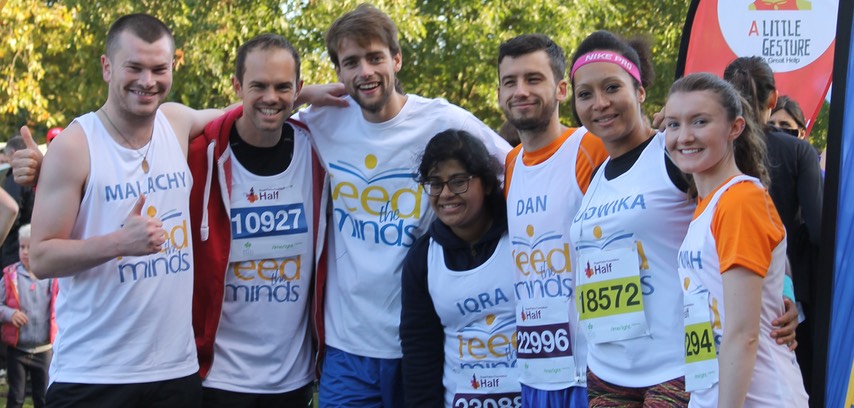
FTM Fundraisers 'Ready for Off’ in the 2016 Royal Parks Half Marathon
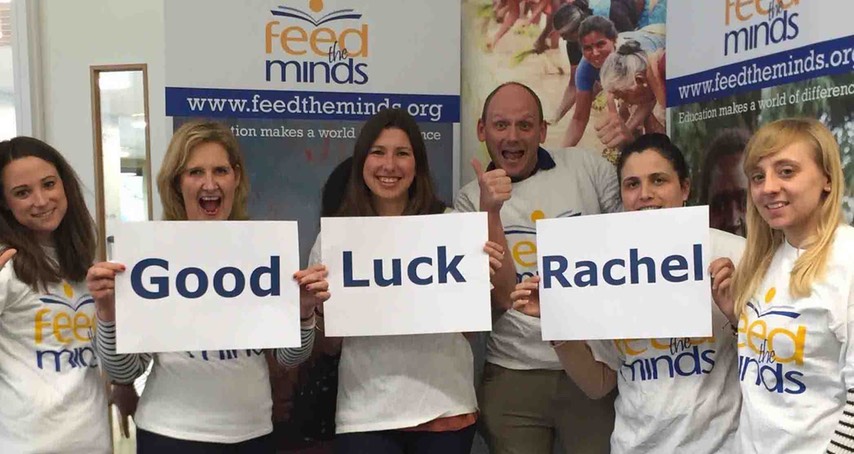
Some FTM Members of Staff Wishing Rachel Good Luck
Where are we Now and Where are we Going?
Three succinct answers to fulfil our Vision and Mission – Education, Collaboration & A Call to Take Risks
For some time 'Education Makes a World of Difference' has been the strapline for our education programmes embodied in a portfolio of projects under 'Education for Change' and this will continue. Every programme or project we are involved in will have as its ultimate goal 'to increase, or give access to, knowledge that is life-changing and empowering', and will be judged on their contribution to this overall goal. We will continue to focus on whole communities, local initiatives, sustainable practices and community development where marginalised individuals get opportunities to be included on more equal terms. This does, in the context of adult literacy, bring a focus on the need for an awareness of gender inequality and structures that reinforce gender disparity, as well as power structures reliant on gender. In the contexts where we work this will bring a coninued focus on women. Women are still overrepresented among people with low literacy skills, which links to their opportunities for full participation in decision making.
Collaborative Partnerships
One strategy to achieve this goal will be collaboration with other organisations, networks and structures. Though relatively small we have already experienced positive collaboration — with partners in the South as members of various networks, and with organisations sharing our ethos in the UK and Ireland through structured collaboration in joint projects or fundraising efforts. This calls for a higher priority, but requires careful planning, due diligence and resources for building relationships. We are also aiming to strengthen our voice in networks and work for common goals without losing our independence or profile. In the coming years we will need to widen our circle of partnerships but with Integrity as one of our core values our ethical stance ensures a firm commitment to honesty, transparency and learning from experience, and means we will not partner with organisations lacking a similar commitment.
High Risk Territory
One thing we have learnt is that innovation requires a certain amount of risk taking. Spotting new opportunities calls for rapid adjustment, and rapid adjustment calls for a shrewd awareness of the risks involved. For an organisation our size we are well positioned to handle it but it often requires staff flexibility, swift decision-making supported by clear operational strategies frequently reviewed and adapted, constant learning and strong financial control systems. Feed the Minds is not lacking in agility, but the speed of change is likely to increase over the next few years in response to the changing environment.
More often than not we find ourselves operating in areas considered to be 'high-risk', due to extreme poverty, post-conflict situations or instability, areas with the greatest need for adult literacy and education. This focus, which is a deliberate choice even if it brings risks and challenges for a small organisation, will continue because we believe it is essential that we respond to our original call to action.
Vision and Mission
Today I find myself leading a small but highly professional and extremely dedicated team in the UK working with with about 20 organisations in projects of various sizes and supporting over 200 institutions in our specific Overseas Book Service programme. In five years we have more than doubled our income. We are supported by major institutional donors such as the Department for International Development and Comic Relief. We may be a small player operating in a wider context but with a confidence to punch above our weight by providing a catalyst for change through strategic collaboration. Modest in size, ambitious in scope.
Looking back, maybe the days of enforced rapid change were a blessing in disguise, because the changes we implemented led Feed the Minds to become much stronger, more professional, and perfectly capable of finding a niche in today's world while at the same time remaining true to the original ethos of its founders. Ten years down the road, as we support partners with life-changing projects integrating adult literacy, we see ourselves, and others see us, as a modern organisation patiently fulfilling that early commitment to helping people live life in all its fullness, contributing to 'a world in which all people everywhere have the opportunity to live life in all its fullness'.
With Core Values of Partnership, Creativity, Diversity and integrity our mission is 'to improve, through education and especially by promoting adult literacy, the material and spiritual lives of communities worldwide'.
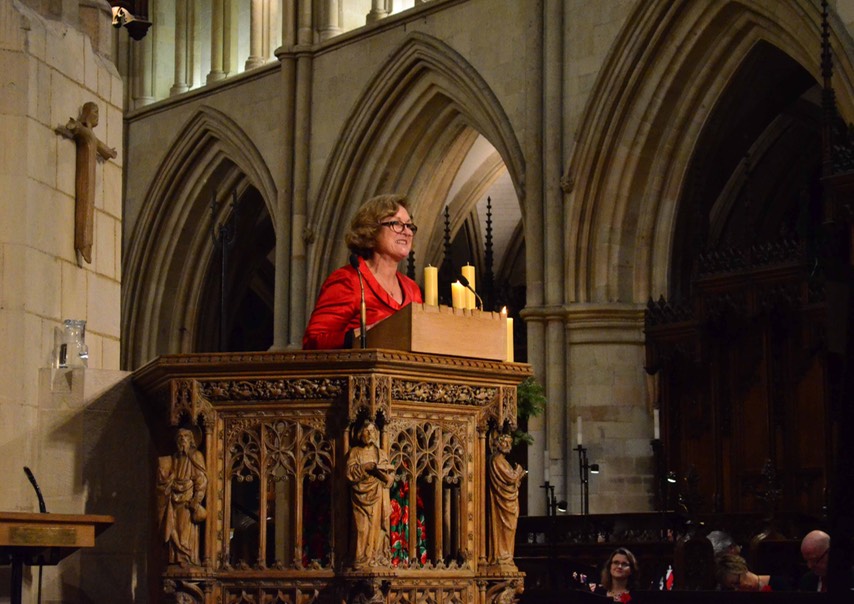
Christine Elliott, FTM Chair, speaking at the newly established Annual Carol Concert in Southwark Cathedral
Legacy from a Scottish Supporter
"KEEP UP THE GOOD WORK"
Exactly what we try to do