
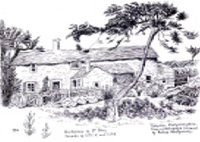
THOMAS BRAY was born on May 2, 1658 at Chirbury in the Welsh borders, an only child who grew up helping his father on the family farm whose unusual gifts at school were noticed by the vicar, and from Oswestry Grammar School he went on to All Souls College, Oxford, where he was regarded as a 'poor boy' and supported himself by menial services to the Fellows. He graduated MA. DD, was ordained in 1681 and became Rector of Sheldon where he remained until shortly before his death despite a short spell in London around 1695. He married in 1686 and by 1688 found himself a widower with two children.
Responding to a call from the Bishop of London to go as his representative to Maryland, Bray left Sheldon for London after a five-year delay during which time he became increasingly aware of the educational limitations of clergy overseas due to a shortage of books, and resolved to do something about it, leading to a programme of libraries for the clergy and the formation of SPCK.
A Man with One Fiddle, Three Strings and Two Stages
THOMAS BRAY, often described as ‘the Founder of SPCK and SPG’ (Society for the Propogation of the Gospel)’ was in fact one of five committed to literacy, literature and libraries at the end of the 17th century. His primary interests were the moral condition of society at home and the need for overseas missionary work but his main motivation was his commitment to books, education and libraries, held together by an over-riding commitment to the poor. Hence the title, ‘a man with one fiddle, with three strings, which he played on two stages’. After 300 years the music still goes on though the melodies have been modified with the passage of time.
Off to Maryland . . . and Back
Despite the delay his personal commitment never wavered and as he sailed down the Channel after selling his personal effects to finance his move he deposited books at Gravesend, Deal and Plymouth. Within two years he was able to report £2,500 spent on libraries and books in America and the colonies, with 30 libraries functioning and another 70 in the pipeline. Each library in the colonies was reckoned at £30 and all the clergy had to raise was £6.
Unfortunately not everything worked as smoothly as he would have wished. He soon came to see that he could help the cause better by working from Britain and came back, first to London and then to Sheldon, for a brief spell (1703-4,) before returning to London in 1706 to take charge of St Botolph’s Aldgate. There he concentrated on his writing and continued his work as teacher and preacher, attracting the youth and continuing to minister to them in his old age. The Charity School connected with St Botolph’s bears his name.
His daily routine involved caring for the poor, teaching the children, visiting parishioners, taking the daily services, preaching sermons and endowing lectures — a busy life for an ageing man. He also trained young ministers and missionaries, supervised their reading and provided a Probationer’s Library. He maintained contact with missionaries in Maryland, sent them books and asked for reports on how their libraries were being maintained.
Continuing his academic interests, in 1729, shortly before he died, he established The Associates of Dr Bray, initially to administer a legacy for the conversion and education of negroes in the Plantations, and it is the successors to this body which still provides theological libraries for the clergy and others through SPCK.
His three-stringed fiddle of books, education and libraries had given place to SPCK, SPG and the Bray Associates, the three institutions which he had plotted out and organised and with which he wished to be associated after his death. He died on February 15,1730 and was buried at St Botolph’s Church.
The Mini Library
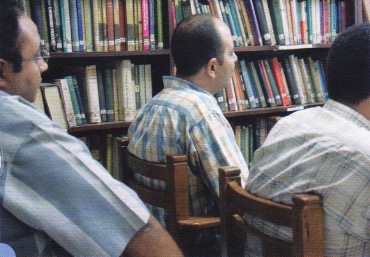
Bray’s Probationer’s Library turned out to be but one crucial building block running right through the story of Feed the Minds. It began with Bray’s recognition that clergy needed books and where books were in short supply every pastor needed access to a mini-library at home. From such humble beginnings, when local libraries were almost non-existent and the supply of good wholesome literarture for all in limited supply, every new reader needed their own set of tools. In developing countries it was the Wall Library. At home it was the foundation for the early publications of SPCK and the Religious Tract Society (Lutterworth Press), became the backbone for the Book Grants both at home and overseas, the foundation for the Book Service and the Theological Book Review, the raison d’être for countless grants to church libraries and Reading Rooms in many a remote community, and the farewell gifts for Eastern Europe pastors on completing their course at the Summer Institute for Theological Education.
A background of books of many kinds – The sine qua non of education and self-fulfilment