
Once up and running FTM set about consolidating the programmes of SPCK, USCL and the work undertaken jointly during the years of the Campaign. The FTM geographical range (Africa, Asia, the Pacific and Latin Amerca) remained unchanged, with Europe featuring little until the arrival of Eurolit.
Consolidation
For SPCK and USCL the new regime called for little change and no major problems. They were now able to continue what they had been doing for a long time and on a firmer foundation. Both readily undertook to channel all overseas requests through FTM and continue substantial grants on a one-to-one basis as they participated fully in the FTM decision-making process whilst at the same time retaining a freedom to handle exceptional cases (where for example FTM was unable or unwilling to respond) from their own Society resources, mostly with the goodwill of FTM.
For a small Movement, with a limited budget, grants were relatively small (up to £5,000 in any one year though often part of an agreed two or three year programme) and mostly to relatively small operations with little or no appeal to the larger mission agencies for whom literature tended to be low priority. This required and enabled close monitoring with a detailed knowledge of the operations, often on a personal basis with regular two-way visits. It also enabled the wide geographical territory to be balanced by the appeal to a wide constituency for funding, reflected in the breadth of FTM’s grant-making overall programme, which included publishing, bookselling and library development with offshoots into literacy and theological education at all levels. Both SPCK and USCL had the privilege of visiting and relating to their Society’s former partners as before but were able openly to share their findings and experiences in the wider FTM partnership.
Applicants now had the benefit of consensus as to terms and conditions, which (in summary) meant that
- FTM Grants were open to all churches and organisations which could claim a connection with Christianity, the content (for example, to what extent it could be described as 'Christian') to be determined by the applicant on the principles previously practiced and defined by the traditions of SPCK, USCL and the FTM Campaign.
- Grants to secular bodies such as local education authorities required some Christian content or clearly defined Christian purpose such as RE textbooks for schools.
Publishing
Publishing requests continued to cover a very broad spectrum, beginning with the basic church requirements (from children’s Bible stories and Christian magazines to prayer books and theological tomes). continuing with aids to development (from books for new readers to titles on agriculture, industrial growth and economics), and finding fulfilment in all forms of the printed word, tapes and cassettes, including novels, local history, stories and customs, myths and legends, plus everthing associated with distribution, from the colporteur to the book van, the bookshop and the warehouse.
By 1960 indigenous publishing, marketting and distribution were all well-established in both India and Sri Lanka with ISPCK in the north of India (closely related to SPCK) and CLS Madras in the south and in Sri Lanka (closely related to USCL). Largely independent, requests for help were few and related mainly to specific pieces of work but relationships were now strengthened in the wider partnership and served as useful points of contact and advice for other requests from that region.
In Africa, except for Zambia with USCL’s involvement in Christian Literature in Lusaka and the Africa Literature Centre (ALC) on the Zambian Copperbelt in Mindolo, Kitwe, publishing relationships focused mainly on East Africa with the production and distribution of Christian literature through the Central Tanganyika Press (CTP) and the (Anglican) Diocesan Literature and Christian Education Centre in Msalato, Dodoma, Tanzania, to which FTM conributed a building for the Library in 1967. At that time CTP was one of three (Anglican) publishing operations in Central Africa, the other two being CTP, Centenary Press (Uganda) and Uzima Press (Kenya).
The Limuru Consultation
In 1973, a Literature Consultation under the guidance of two publishing professionals, Albert ('Bertie') Manuel on behalf of FTM and Henry Okullu, a trained and well-known journalist in Kenya, met in Limuru to examine the printing and publishing operations of three Anglican churches (Tanzania, Uganda and Kenya), at which it was agreed to incorporate Uzima Press as an independent publishing house and to develop indigenous Kenyan professional staff to run it. The decision was backed by a five year strategic literature plan, sponsored partly by FTM who had supported the church publishing in Kenya for many years, and as a starter SPCK handed over the publishing rights to eleven of their Kenya publications which became the bread-and-better lines for Uzima over many years.
The Consultation had further and wider significance for both donors and receivers in that it identified three principles for giving and receiving grants from Literature agencies:
- Money given for buildings considered necessary for the proper development of the church’s writing, publishing and distribution of literature to be used only for these purposes.
- If at any time such premises were temporarily not fully occupied for these purposes any acquired rent or other income to be credited to Christian literature development.
- Should the property for any reason be used for purposes other than those for which the funds were originally given, the donor to be consulted and given the opportunity of accepting re-imbursement at current market value or proposing alternative means whereby the funds may be re-deployed.
To some extent by clarifying the protocols for grant-making the Limuru Consultation inaugurated, or at least paved the way for raising standards of professionalism which became an important feature of FTM grants, whether for printing and publishing, bookselling and distribution or librarianship.
The next move towards a greater professionalism was the creation of the FTM Scholarships Programme for students, either from overseas or about to work overseas, to enable them to learn their craft. Initially this meant a couple of terms studying appropriate modules in Third World Publishing at the Oxford Polytechnic (now Oxford Brookes University) with three key elements: book design, editing and the history of publishing. The Programme continued until the early 1980s when circumstances changed and it was more appropriate as well as economic to train students in or near to their own culture, at which point well-established bodies like ISPCK and CLS Madras (both earlier offsprings of SPCK and RTS/USCL), put on suitable courses which FTM simply financed.
Shortly after the Consultation, Horace Etemesi, then a theological lecturer at St. Paul’s College in Limuru, was recruited by Uzima Press in Kenya as an editor trainee and became one of the first four benficiaries of the Scholarships programme, alongside Alex Chibehe, then asistant manager of CTP, Tanzania, followed by a steady stream, many of whom on their return made important contributions back home. Three months after his return Etemesi became Manager of Uzima, a post which he held for the next fourteen years before joining the staff of the World Association for Christian Communication in London.
The nature and content of publishing varied considerably from books for children to more speciaiist material for clergy, laity and adult education in general, including magazines and newsapers for all ages and the story is best told through the experience of a few key partners.
In STEP with Bedan
STEP started its life in Kenya in the early 1980s, the beneficiary of FTM grants for many years and an important landmark in the development of African literature. It was the brainchild of Bedan Mbugwa, driven by the potential resourcefulness of his own generation and his commitment to education and communication at a tough time in their nation’s history.
Bedan's resourcefulness led him to motivate and organize a few of his contemporaries to address straightforward problems in an imaginative way for the benefit of the local community. His commitment to education led him to take himself off to the USA to study journalism and when he returned the creation of STEP was the result.
Directed specifically to children and young people, STEP was just about the nearest you could get to Boys’ Own Paper or Girls’ Own Paper though Bedan knew nothing of either. He was simply responding to the same need as that which created those two outstanding USCL productions. George Andrew Hutchison, editor of Boys' Own Paper for 33 years, said BOP would succeed ‘if it is written for boys not for grandmothers’. Bedan said and STEP succeeded on all three counts.
'Christian literature must look as attractive as secular literature,
must be capable of selling in the commercial market
and must hold its own on the newstands in the street.'
In the tradition of a broad understanding of the Christian faith STEP reflected a holistic approach to life as it addressed the day-to-day problems of young Christians with a quality of writing 'where young people were and not where "dog collars" thought they ought to be'. For example, how long were they to go on 'obeying their parents', how were they to respond to gossip, birth control or treatment of servants, and one edition in Ghana carried articles on HIV/AIDS prevention education, sanitation and the education of girls with strong emphases on Christian principles.
With that objective and approach FTM had no hesitation in backing it with warm support from both USCL and SPCK as it spread from Kenya, proving equally popular in Ghana, Nigeria, Uganda, Zambia, Zimbabwe and Burkino Faso (in French).
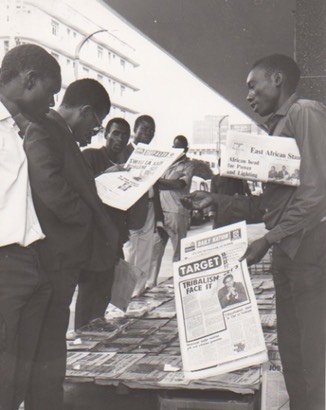
Target (in English) and Lengo (in Swahili), for example, two highly popular African newspapers with a broad spectrum, a political bent and a Christian angle, received much FTM support in their early days. Normally issued once or twice a month they were sufficiently adaptable to turn up on a daily basis for the whole three weeks during the Assembly of the World Council of Churches in Nairobi, 1975, and much sought after by delegates to find out what was going on and how it was being seen and reported by the local African churches.

Certeza Argentina
Certeza Argentina, a non-profitmaking organisation based in Buenos Aires and in the 1980s one of FTM’s closest and most consistent partners in Latin America, started its life as Ediciones Certeza after the fashion of SCM and IVP with a mission to provide informative books on Christianity for students. Beatriz Bono, Certeza Editor, was one of the pioneers in her student days and stayed solidly with the Company for more than 20 years.
In a part of the world where most publications were imports or translations from English, where few books were written by Latin Americans, with a dearth of biblical teaching in the churches and such as there was dominated by Roman Catholicism and North American Fundamentalism, mostly focused on didactive and rote-learning techniques, Beatriz and her collegaues committed themselves to publish books for and by Latin Americans and (despite Argentina’s many economic crises and a chronic lack of publishing capital) to focus on 'the inductive method' encouraging readers to ask questions and apply the Bible to daily iiving.
Classic contemporary Christian titles were translated, Latin American authors were encouraged and supported and in the late 1980s contributed 40 out of 80 titles on their list. The first Certeza bookshop opened in 1980 and became a strategic distribution point for other bookshops in the suburbs. On a day-to-day basis bookselling and publishing were self-supporting but depended on grants for capital purposes, special projects, new technology and consultancy visits by specialist personnel who gave practical training and encouraged regular evaluation and withoout which it is doubtful whether they could ever have achieved the indigenous list which they did. As Argentina’s only ecumenical publisher Certeza found itself in a unique position to support both church and society by promoting deeper dialogue among Christians and a biblical analysis of the social, political and spiritual reality.
Verbo Vivo, Peru
In Peru, wealthy land of the Incas, with most of the resources in the hands of a few, 40% of the population living below the poverty line and 750,000 in abject poverty, many in shanty towns around Lima without lighting, water or sewage, and where most of the people did not speak Spanish, providing good reading material presented its own problems, Feed the Minds cooperated with Verba Vivo (Living Word) to respond to the needs of more than 100 indigenous languages to maintain a steady supply of books for children and young people, through schools and churches in Argentina, Chile, Venezuela, Honduras and Guatemala.
Lotu Pasifica Productions, Fiji
Lotu Pasifica Productions (LPP) was founded in 1973 with a grant from WACC to meet the publishing requirements of the Christian churches in the Pacific Islands. About 1980, new management was installed and the emphasis moved from English books for the region to Fijian books for Fiji so as to provide a better economic base from which to serve the other islands. LPP produced books for schools on behalf of the Ministry of Education, pioneered Ladybird books in the Pacific by taking subsidised coloured sheets from the UK and inserting their own texts, became distributors for a series of children’s books from Japan and developed a Creative Writing competition promoted on Radio Fiji three times a day for two months with a prize of F$600.
By 1990 their list, which had grown to 40 titles (25 in Fijian, 10 in English and 5 others) with sales rising rapidly, showed a small operating profit for the first time and they were able to acquire new headquarters. Grant aid from six donors, including FTM, all for specific projects and mostly for small pieces of machinery, had put LPP in the vanguard of Third World publishers with a commitment to computerisation and modern technology as a means of production.
As they looked back at the decade with some satisfaction, they could never forget how the change had required a re-thinking of their whole programme, a reorgansisatiion of personnel, authors, proof readers, etc, and a full survey of local need, with many trials and failures on the way, Because 'Lotu' in Fijian means 'church' and came to cause confusion in some people’s minds wth the arrival in the region of a number of 'strange sects'. using 'church' to describe themselves, the name was changed to Sunrise Publishers.
Bengal Christian Literture Centre
Bengal CLC has a long history of partnership with FTM’s forbears going back well before the arrival of FTM and in an unusual if not a unique position, situated in the commercial heart of Calcutta with a strong commitment to Christian mission and education. As the only publisher of Christian books in Bengali, CLC saw itself as essentially in the commercial publishing world rather than in an office or department of the more narrow religious world of church headquarters, seeking Christian interpretations and solutions to the problems of Bengal rather than confining themselves to prayer books and Bble commentaries. Local curches greatly valued its contribution, in one case saying that 'if Bengal CLC did not exist it would be necessry to invent it'. Suffering the loss of traditional missionary support in the post colonial era it depended very much on specialist literature agencies such as FTM for its survival.