
England at the End of the 18th Century
Iin the aftermath of the French Revolution, followed by a series of bad harvests, food crises and the sixpenny edition of Tom Paine’s The Rights of Man England was not quite the country in which the SPCK Founding Fathers had found their motivation a century before, but some things had not changed.
Thanks to a century of SPCK, the Charity Schools and the Sunday School Movement, Britain was beginning to have a new class of literates in every town and village. Unfortunately numbers failed to keep pace with an expanding population and reading material was sparse and poor. New readers were a prey to door-to-door salesmen selling books and tracts of dubious quality and the new evangelicals, in the mode of Wesley and Whitfield, were offended and challenged. A new initiative was called for. This time it had to be interdenominational and in 1799 a lead from the London Missionary Society (LMS) gave birth to the
Religious Tract Society (RTS)
Similarities between SPCK and RTS were surprisingly close. Both were committed to literature and education, at home and overseas. Both began with a small group of enthusiasts. Both were voluntary Societies born out of a common Christian concern, and neither was structurally part of the churches. The main difference was that whereas SPCK was entirely Anglican the RTS Committee had an equal number of representatives from Anglican and Free Churches (Baptist, Congregational, Methodist and Presbyterian) on its Committee, with an Anglican Secretary and a Free Church Secretary, and an equal number of ministers and laity. A minor difference perhaps was that when it came to specific Christian teaching SPCK tracts tended to focus on church and liturgy while RTS tracts tended to be more biblical and mostly had to include ‘some account of the way of salvation’, though both attacked the same social evils albeit from a slightly different doctrinal basis.
RTS owed its oriigins to the Rev George Burder, a Coventry Congregational minister who came to a meeting of the newly formed London Missionary Society in May 1799 ‘with tracts in his pockets’ and in the course of the gathering invited all those who shared his concern to meet him afterwards in an adjoining schoolroom. Next morning at 7, forty of them met in St Paul’s Coffee House, the first of a series of Breakfast Meetings to be held almost in unbroken succession until 1939. On May 10, at one of those meetings, the RTS was born.
Four Facets to the RTS Programme
- A general Tract Depository run by a part-time agent who in seven years produced and distributed 3.5 million tracts and found space to store 800,000 and 650 reams of paper.
- A commitment to publishing tracts with the Committee as a corporate editor and the weekly Breakfast Meeting busying itself editing tracts and booklets. Every tract had to have a cartoon drawing on the cover and early titles included 'The Fortune-Teller’s Conjuring Cap', 'The Wonderful Cure of General Naaman', 'The Stingy Farmer’s Daughter' and 'Tom Taper’s Tale over His Jug of Ale'.
- By 1815 no fewer than 124 Auxiliaries, all distributing RTS titles, had been set up to encourage the creation of similar Societies all over the country.
- The development of a huge foreign correspondence as they addressed the needs of people in Europe, British colonies and Dependencies, and in Protestant missions everywhere. Tracts were translated into many languages — German, Spanish, Arabic, Modern Greek, Russian, Portuguese, Gaelic and Welsh — and contact established with the army, navy, prisoners (including prisoners of war) and workhouses.
From Simple Tracts to full-blown Publishing
By 1820 RTS dipped its toe into publishing. Pilgrim’s Progress came first at 8 pence a copy, followed by two magazines in 1824, a quarterly (which soon morphed into a monthly and then a weekly in 1828) and of course books for children As with SPCK's 'Bray Gospel’ the RTS Gospel was equally all-embracing, reflecting the Society’s understanding of the wholeness of Christianity covering subjects such as history and culture, with Our Domestic Fowls and Song Birds and The Life of Julius Caesar sitting side by side with The Life of Luther and Wild Flowers of the Year.
Also like SPCK, RTS which began a 'home mission was not long in extending ‘home’ to the far corners of the earth. By the end of its 12th year its overseas work was an integral part of its programme, and by 1849 over £30,000 had been voted for Tract and Book Societies in India specifically to facilitate local production overseas.
By this time the magazine business in Britain was booming, powered by a new popular emphasis on 'Religion for the Home', thanks to commercial prosperity, more leisure and larger families contributing to a new appreciation of home and family life. SPCK was responding and RTS had no intention of being left behind.
First, The Leisure Hour in 1852, (weekly for one penny) which lasted until 1906, quickly followed by The Visitor. The Sunday at Home began a year later, one of its most popular serials being Jessica’s First Prayer, published in book form in 1868. A third, The Young Cottager, arrived in 1830 followed by books on natural history. The Monthly Volume, a small varied library of 100 titles, priced at 6 pence or 10 pence according to the binding, ran from 1845-54 and of which, when introducing the series in The Spectator, Dr Arnold said,
‘I never wanted articles on religious subjects half so much as articles on common subjects with a decidedly Christian tone’.
Falling sales, increasing secular education (due in part to the 1870 Education Act) and the decline in evangelicalism towards the end of the 19th century led to the offer of prizes in voluntary examinations in Bible Knowledge in the London Schools.
Then in January 1879 RTS launched its flagship with the monthly Boys’ Own Paper (price one penny) to counter the ‘penny dreadful’, followed a year later by a sister ship, Girls’ Own Paper (also one penny), alongside Little Dots (for younger children). With limited overt Christian teaching in its content doubts were expressed as to whether it would succeed, to which George Andrew Hutchison, the distinguished BOP editor for 33 years whose writers included Jules Verne, Conan Doyle and W G Grace, replied
‘It will if it is written for boys not for grandmothers’.
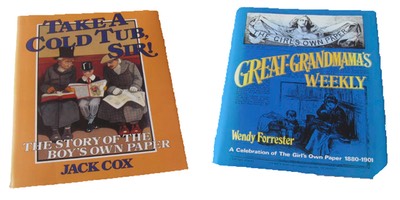
Two memorial volumes, Take a Cold Tub, Sir! and Great-Grandmama’s Weekly arrived in 1980 and 1982 respectively.
Thanks to John Murdoch, RTS developed links with India, similar to those of SPCK with ISPCK (Indian Society for the Promotion of Christian Knowledge, leading to the creation of the Cnristian Literature Society (CLS, Madras), and in Britain developed its own publishing house, adopting the name of Lutterworth Press in 1932 to honour John Wycliffe whose 'poor preachers' were reputed to have gone from the parish in Leicestershire village of Lutterworth where the vernacular Bible was prepared. The Lutterworth Library of 35 volumes, mostly translations from continental theologians, became well-known all over the world and children’s titles included such popular authors as Enid Blyton, Malcolm Saville and Kathleen Fiddler.
After merging with its daughter societies in India, Africa and China RTS became the United Society for Christian Literature and dropped the RTS imprint altogether in 1941 in favour of Lutterworth Press.